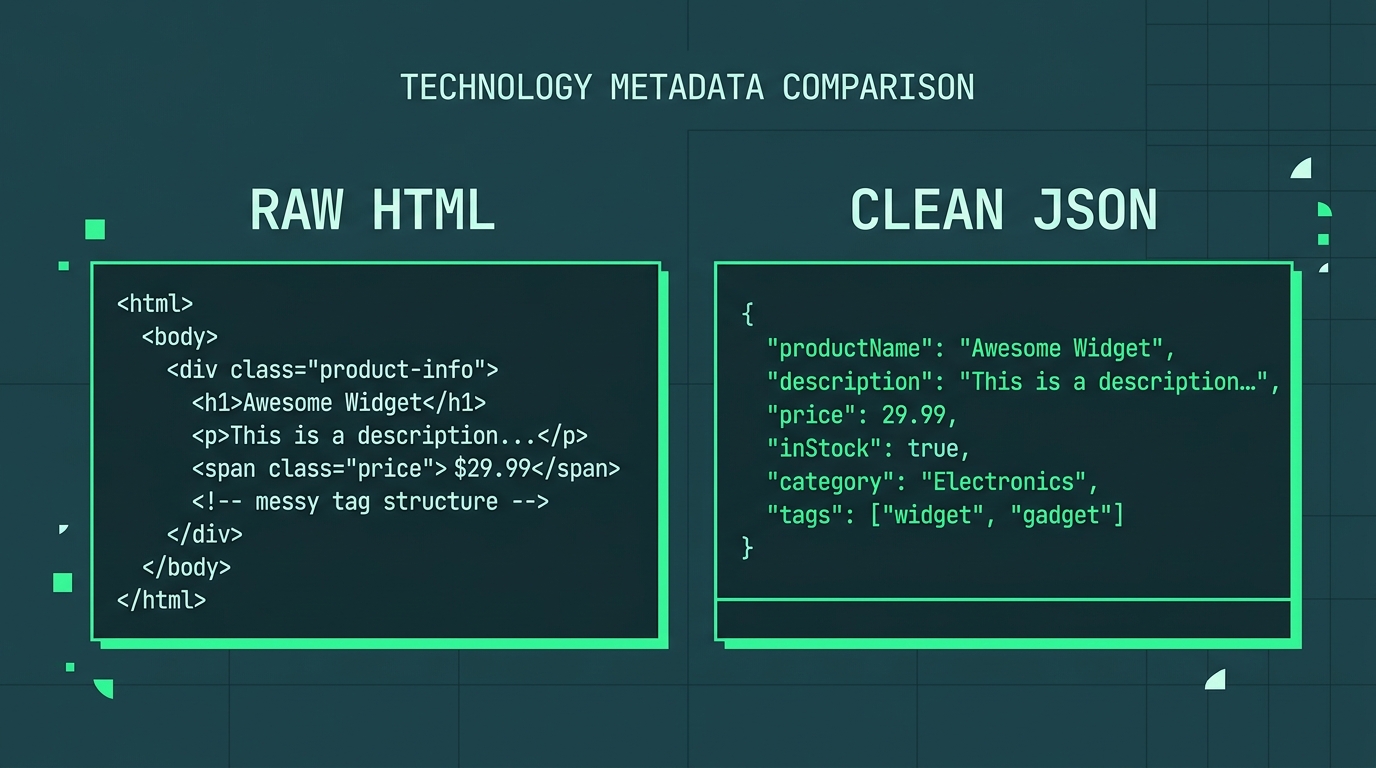
Most search APIs built for LLMs return web snippets. You send a query, and the API returns a list of raw text fragments scraped from HTML pages.
For general-purpose QA or drafting emails, this is fine. But if you are building an AI agent to handle compliance, medical research, or legal audits, snippets are a liability.
An agent reading a text chunk cannot verify its authority, check if it is active, or filter by specific jurisdictions. To make high-stakes decisions, agents need normalized metadata, not raw text. In financial domains, for instance, this requires querying official endpoints (see Accessing SEC EDGAR) to retrieve validated corporate sheets rather than third-party financial blog summaries.
The Limits of a Text Snippet
Suppose you ask a compliance agent to verify standard operating procedures for handling clinical trial data in the EU. A snippet-based API might return this:
{
  "title": "Clinical Trial Guidelines",
  "snippet": "...under the new rules, trial sponsors must submit results to the EU database within 12 months of the trial's completion. Failure to comply leads to..."
}
This snippet looks plausible. But the LLM cannot answer these questions:
- Which specific EU regulation does this refer to?
- Is this rule currently in force, or is it a draft proposal from 2021?
- Who published this guideline? Is it the European Medicines Agency (EMA) or a blog post?
Without these answers, the agent has to guess. It has to rely on its parametric memory or assume the context is current. In regulated domains, guessing leads to compliance failures.
The Structured Alternative
Instead of scraping surface HTML, DEEP⌟ queries institutional databases directly and normalizes the results.
Here is what the same query returns from our EUR-Lex connector:
{
  "source": "EUR-Lex",
  "document_id": "32014R0536",
  "title": "Regulation (EU) No 536/2014 of the European Parliament and of the Council on clinical trials...",
  "type": "regulation",
  "authority": "European Parliament and Council",
  "status": "applicable",
  "effective_date": "2022-01-31",
  "last_amended": "2024-03-12",
  "jurisdiction": "EU",
  "abstract": "This regulation aims to simplify and accelerate the authorization of clinical trials while maintaining high patient safety standards...",
  "url": "https://eur-lex.europa.eu/legal-content/EN/TXT/?uri=CELEX:32014R0536"
}
This payload gives the agent the facts it needs to make logical decisions.
Writing Deterministic Agent Logic
With structured metadata, you do not have to rely on the LLM to guess the context. You can write deterministic python filters directly in your tool pipeline before the data reaches the LLM context window:
def filter_authoritative_sources(results):
    valid_results = []
    for doc in results:
        # Reject stale guidelines
        if doc.get("status") != "applicable":
            continue

        # Ensure the source is the official regulating authority
        if "European" not in doc.get("authority", ""):
            continue

        valid_results.append(doc)
    return valid_results
By filtering on status and authority before the LLM reads the text, you eliminate the risk of the model hallucinating from old drafts or unofficial commentaries.
If you are building agents that handle high-stakes actions, design your pipelines around normalized metadata. Text chunks are for chatbots; structured data is for utility. To see how to enforce these schemas across different endpoints, read our system blueprint for eliminating the connector tax.