AI compliance agents operating in European jurisdictions cannot rely on surface web content. They must query the official repository of EU law directly through the EUR-Lex Web Services.
EUR-Lex provides access to primary and secondary legislation, case law, and preparatory acts. However, unlike modern REST APIs, EUR-Lex uses a SOAP web service interface and expects requests formatted in XML envelopes containing a Contextual Query Language (CQL) query.
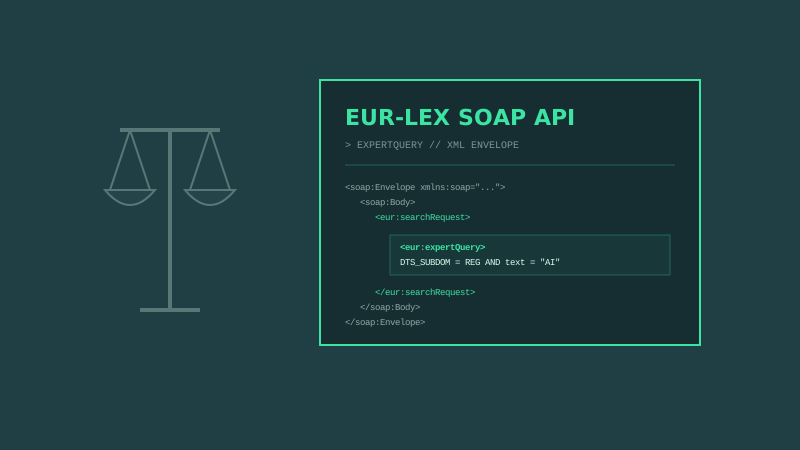
For example, to search for EU regulations matching a specific text search (e.g., “artificial intelligence”), you send a POST request with an XML payload defining your query:
<soapenv:Envelope xmlns:soapenv="http://schemas.xmlsoap.org/soap/envelope/" xmlns:eur="http://eur-lex.europa.eu/search">
   <soapenv:Header/>
   <soapenv:Body>
      <eur:searchRequest>
         <eur:expertQuery>DTS_SUBDOM = REG AND text = "artificial intelligence"</eur:expertQuery>
         <eur:page>1</eur:page>
         <eur:pageSize>10</eur:pageSize>
      </eur:searchRequest>
   </soapenv:Body>
</soapenv:Envelope>
The response is returned as SOAP-XML, which must be parsed to extract metadata fields like the CELEX number, date of effect, and legal validity. Decoupling this complex XML parsing from your agent’s reasoning loop is essential for stable legal RAG pipelines. Additionally, legal SOAP endpoints are notoriously slow; to prevent these queries from stalling your entire pipeline, configure them inside a system with parallel query routers (see our design patterns for resilient federated search).