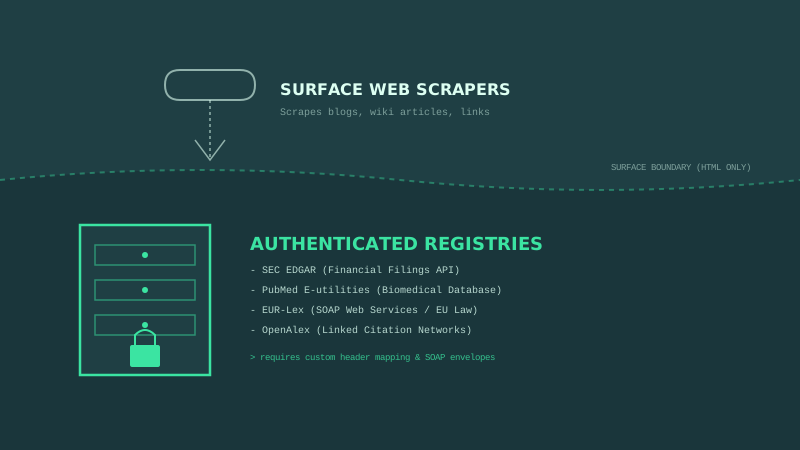
When building RAG systems for regulated industries, accuracy is not a preference; it is a legal requirement. A medical AI agent prescribing treatments based on a blog post description is a liability. A financial agent auditing assets based on third-party stock-tracker scrapes will produce stale, incorrect figures.
Many developers assume that web search APIs (like Tavily or Exa) or broad crawler tools (like Firecrawl) can fetch anything (read our comparison of grounding options in Beyond Google Search). They cannot. They only index the surface web—content that is public, easily crawlable by simple HTML parsers, and free of authentication constraints.
High-stakes data is locked behind official database gateways. To retrieve it, you must bypass general search engines and query the authoritative registries directly.
Here are four high-integrity sources that general web crawlers miss:
1. SEC EDGAR (Financial Regulatory Filings)
The U.S. Securities and Exchange Commission (SEC) repository holds every official corporate filing, from quarterly 10-Q reports to annual 10-K sheets.
- Why crawlers miss it: The SEC EDGAR system blocks generic user agents to protect its servers from DDoS-like scraping. If your scraper doesn’t declare a valid, company-identifying
User-Agentheader, it receives a403 Forbiddenresponse. - The Query Rule: Filings are cataloged by the company’s Central Index Key (CIK), padded to 10 digits (e.g., Apple Inc. is
0000320193). - Python Request Pattern:
import requests

headers = {
    'User-Agent': 'AcmeCorp/1.0 (compliance@acme.com)',
    'Accept-Encoding': 'gzip, deflate'
}
# Fetch Apple's submission list
url = "https://data.sec.gov/submissions/CIK0000320193.json"
response = requests.get(url, headers=headers)
data = response.json()
2. PubMed E-utilities (Biomedical & Life Sciences)
PubMed catalogs over 37 million citations from MEDLINE, life science journals, and online books.
- Why crawlers miss it: It is a two-step federated database. You cannot query a document directly via a URL. First, you must execute a search (
esearch.fcgi) to receive a list of PMID document IDs. Second, you must fetch the abstract metadata using those IDs (esummary.fcgi). - The Query Rule: Query payloads require specific database parameters (e.g.,
db=pubmed) and returns structured XML or JSON records instead of standard HTML pages.
3. EUR-Lex Web Services (European Union Law)
EUR-Lex provides official access to primary and secondary EU legislation, treaties, and case law.
- Why crawlers miss it: Unlike modern REST APIs, EUR-Lex uses a legacy SOAP web service interface. It rejects typical JSON requests.
- The Query Rule: Requests must be wrapped in XML SOAP envelopes and contain queries formatted in Contextual Query Language (CQL) (e.g.,
DTS_SUBDOM = REG AND text = "artificial intelligence"). Keyword indexes cannot map or execute these operations.
4. OpenAlex (Scientific Citation Network)
OpenAlex is a free, open index of over 250 million global scientific works, authors, institutions, and concepts.
- Why crawlers miss it: Surface search engines index individual HTML article pages, but they cannot index the citation network—the relationships between papers, authors, and co-citations.
- The Query Rule: To fetch the research citation graph without hitting rate limits, developers must query OpenAlex’s polite API pool by passing their email in the contact parameter:
curl "https://api.openalex.org/works?filter=publication_year:2024&mailto=dev@company.com"
If you are building compliance, legal, or medical RAG systems, stop scraping blog posts. Replace generic surface search loops with federated connectors that map queries directly to these authoritative APIs. To learn how to build this unified mapping framework, see our blueprint for eliminating the connector tax.
By standardizing integrations at the infrastructure level—rather than trying to extract data from raw HTML scrapers—you ensure that your AI agents operate on verified, source-traced truth.